
13 min read
Car Tyre Puncture & Replacement in Dubai: What Should You Do?
Got a flat tyre in Dubai? Learn when a punctured tyre can be repaired, when replacement is necessary, roadside safety steps, and how mobile tyre repair works.

Got a flat tyre in Dubai? Learn when a punctured tyre can be repaired, when replacement is necessary, roadside safety steps, and how mobile tyre repair works.
A tyre puncture can happen without warning. You may notice the steering suddenly feels different, see a tyre-pressure warning on the dashboard, hear an unusual sound from one wheel, or return to your parked car and find that one tyre has gone completely flat.
For drivers in Dubai and across the UAE, a flat tyre can be especially inconvenient on a busy road, inside a parking facility, during a long journey, or in the middle of the summer heat. The important thing is not to panic or continue driving on a damaged tyre unnecessarily.
Depending on the type and location of the damage, the tyre may be repairable. In other situations, replacing it is the safer option. This guide explains what causes tyre punctures, what to do when you get a flat tyre, when repair is possible, and how mobile tyre assistance can help you get back on the road.
Slow down gradually, move to a safe place, and avoid driving any farther than necessary on a deflated tyre. A small puncture in the main tread may be repairable after inspection, while sidewall, shoulder, structural, or run-flat damage often requires replacement. If the car cannot be moved safely, a mobile tyre technician can inspect and repair or replace the tyre at your location.
A tyre can lose pressure for several reasons. Some punctures happen instantly, while others create a slow leak that takes hours or days to become noticeable.
Common causes include:
Construction activity can increase the likelihood of nails, screws, and metal fragments reaching nearby roads. Even a small object can penetrate the tread and allow air to escape gradually.
Some punctures are obvious, but a slow puncture can be harder to identify. Warning signs include:
If the same tyre keeps losing pressure, have it inspected instead of repeatedly reinflating it. The source may be a puncture, valve leak, poor bead seal, or wheel damage.
Your first priority is to get the vehicle and its occupants to a safe location. If you notice a tyre problem while driving, reduce your speed gradually and avoid sudden braking or steering. Move to a safe parking area, service road, or another suitable location if it is safe to do so, and use your hazard lights where appropriate.
Once stopped, inspect the tyre from outside the vehicle. Do not stand where passing traffic could put you at risk, and do not automatically continue driving simply because the car can still move.
Driving on a tyre with very low or zero pressure can damage the sidewall and wheel. A puncture that might have been repairable can become irreparable after the tyre has been driven while flat.
Generally, you should avoid driving any significant distance on a flat conventional tyre. A tyre relies on air pressure to support the vehicle and maintain its shape. When the pressure becomes too low, excessive sidewall flex can cause internal damage.
Continuing to drive can lead to:
If the tyre is losing pressure quickly, stop safely and arrange assistance rather than trying to reach a workshop.
Sometimes. A puncture does not automatically mean that you need a new tyre. Whether a repair is appropriate depends on:
A small puncture in a suitable part of the main tread may be repairable after the tyre is properly inspected. Simply seeing a nail in the tread is not enough to make that decision, because damage inside the tyre may not be visible from the outside.
Replacement may be necessary when the damaged area cannot be repaired safely or the tyre has already suffered structural damage.
The sidewall flexes continuously while the car moves. Cuts, bulges, and punctures in this area are more serious than a small puncture in the central tread and commonly mean the tyre needs replacement.
The shoulder is where the tread transitions into the sidewall. Damage close to this area may not be suitable for a conventional repair.
A large hole, cut, tear, or multiple nearby punctures may make a safe repair impossible.
A tyre may look repairable from the outside but have internal sidewall damage caused by carrying the car without enough pressure.
Repairing the puncture may not make sense if the tyre is already near the end of its usable life or shows other structural deterioration.
If a relatively new tyre has a small, repairable puncture in the tread area, repair may be the most practical solution. If it has sidewall damage, severe wear, cracking, or structural deterioration, replacement is usually more appropriate.
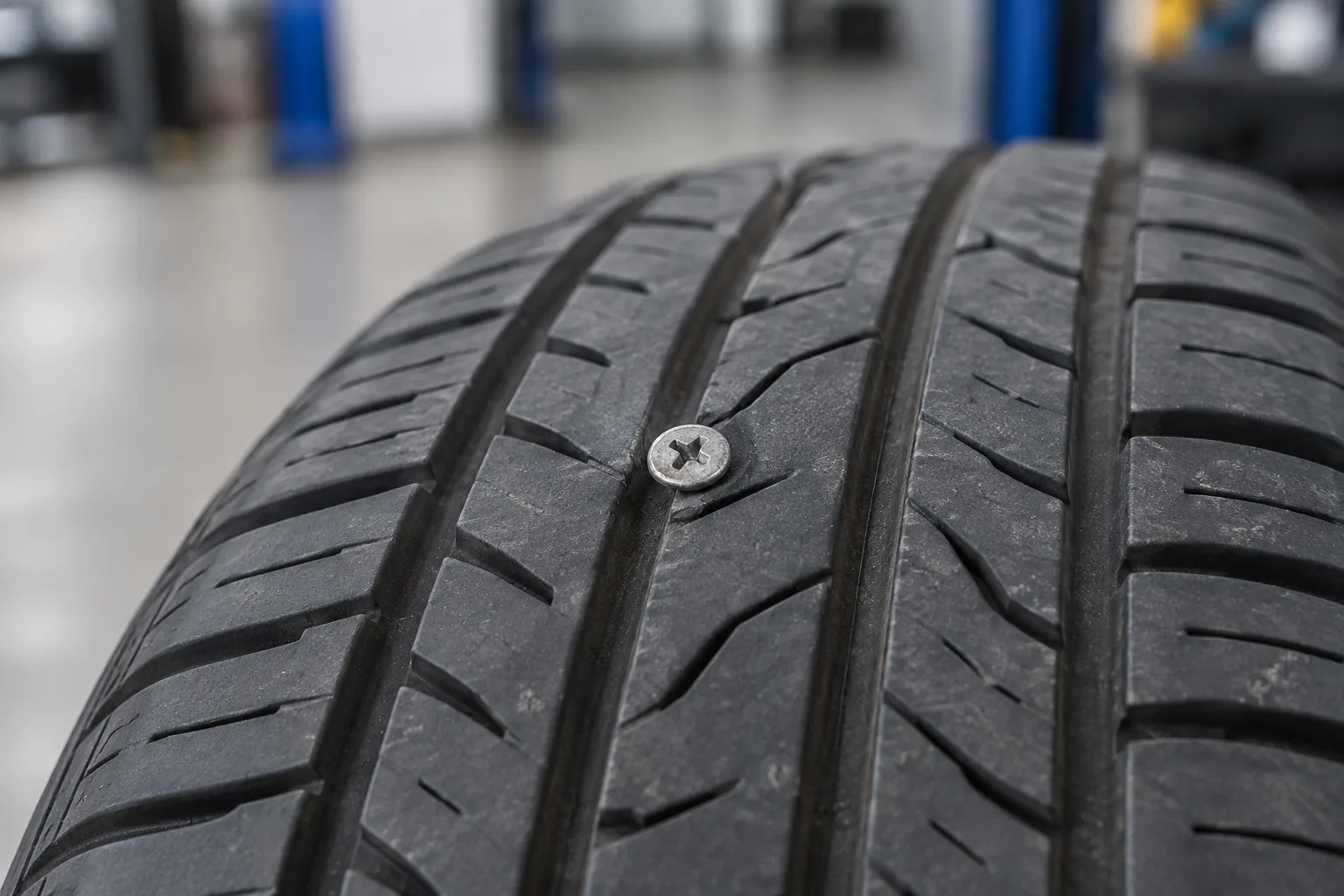
A proper inspection should answer two separate questions:
The second question is just as important as the first.
In many situations, yes. Mobile tyre services allow a technician to come to the vehicle instead of requiring the driver to reach a tyre shop first. This can be useful at home, at work, in a residential community, in a suitable parking facility, or at a safe roadside location.
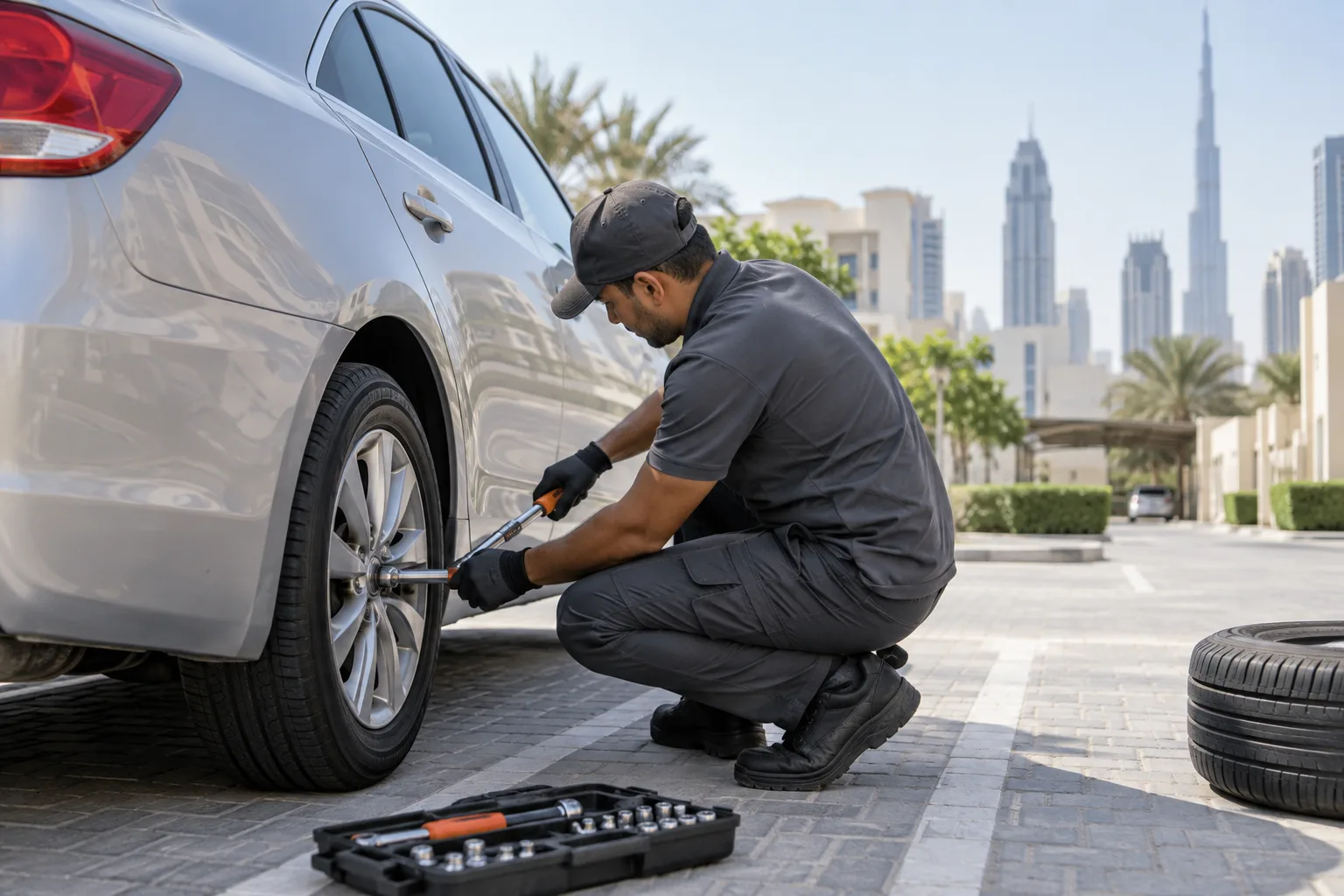
For drivers looking for mobile car puncture repair in Dubai, 800Motor offers on-site inspection, puncture repair, tyre replacement, balancing, and safety checks at homes, roadsides, and parking locations across Dubai.
Mobile assistance can be particularly useful when driving the vehicle to a workshop would risk causing additional tyre or wheel damage.
You provide your location, vehicle make and model, tyre size if known, and a description of the problem. Photos may help the technician understand the situation before arriving.
The technician checks tyre pressure, tread condition, puncture location, sidewall, valve, and visible wheel damage.
A nail or screw may be obvious, but some leaks come from the valve, wheel, bead seal, or another damaged area.
If the tyre can be repaired safely, the technician can use the appropriate repair method. If it is unsuitable for repair, replacement may be recommended.
Before the vehicle returns to the road, the tyre should be inflated to the pressure specified for the vehicle and checked to confirm that the leak has been resolved.
Usually, there is little benefit in immediately pulling an object out while the vehicle is parked. A nail or screw may partially restrict the leak, and removing it can cause the tyre to lose pressure much faster.
If the tyre still has pressure and the car is already in a safe location, leave the object in place until the tyre can be inspected. Do not assume the tyre is safe merely because it has not yet gone flat.
Some vehicles include emergency sealant and a compressor instead of a spare wheel. These products can sometimes provide a temporary way to move the vehicle, depending on the type of damage.
A temporary mobility product is not automatically equivalent to a professional repair. Follow the vehicle manufacturer's instructions, including any speed and distance restrictions, and arrange a proper tyre inspection afterwards.
If your car has a suitable spare and you know how to change it safely, fitting the spare may let you continue your journey. However, changing a wheel beside a busy road can be dangerous. Do not attempt it where passing traffic, unstable ground, heat, or poor visibility makes the situation unsafe.
Many cars use temporary space-saver spare tyres with limits on speed and driving distance. Check the instructions supplied with your vehicle.
Many modern cars no longer carry a full-size spare wheel. Instead, they may use run-flat tyres, a temporary mobility kit, tyre sealant, or a compressor. If these options cannot get the car moving safely, mobile tyre assistance or vehicle recovery may be required.
Run-flat tyres are designed to support a vehicle for a limited period after pressure is lost. That does not mean they can be driven indefinitely while flat. The permitted speed and distance depend on the tyre and vehicle manufacturer.
A run-flat tyre that has been driven without pressure may require replacement even when the original puncture looks small. Follow the manufacturer's guidance and have the tyre inspected.
Yes. Not every flat tyre is caused by a puncture. A bent or damaged wheel can interfere with the seal between the tyre and rim, causing a slow leak. A strong impact with a pothole or kerb can also damage the tyre, suspension, or wheel alignment.
If a tyre repeatedly loses pressure and no puncture is found, the wheel, bead seal, and valve should also be checked.
Temperature affects tyre pressure, so regular checks are worthwhile in the UAE climate. Use the pressure recommended by the vehicle manufacturer, which is normally shown inside the driver's door area, near the door frame, inside the fuel flap on some cars, or in the owner's manual.
Do not use the pressure moulded into the tyre sidewall as the normal inflation target. That marking is not the vehicle manufacturer's recommended operating pressure.
Check tyre pressure regularly and before long journeys. During a quick visual inspection, look for:
Uneven wear may point to incorrect pressure, wheel alignment, balancing, or suspension problems. Replacing a tyre without identifying the underlying cause can allow the same problem to return.
The answer depends on the vehicle, drivetrain, remaining tread, and manufacturer's recommendations. Tyres on the same axle should have compatible specifications and reasonably similar performance characteristics.
Consider tyre size, load and speed ratings, tread design, tyre type, and existing tread depth. All-wheel-drive vehicles may have tighter limits on differences in tyre circumference, so check the manufacturer's guidance before replacing only one tyre.
A flat tyre and a dead battery are different problems, but either can leave a car unable to continue. A weak battery may need testing, a jump start, charging, or replacement. A damaged tyre may need inflation, puncture repair, a spare wheel, tyre replacement, or mobile assistance.
Identifying the cause before replacing parts saves time and money. If the car will not start but the tyres appear normal, see our roadside battery services in Dubai for battery testing, jump-start assistance, and replacement at your location.
Know whether your car has a spare, run-flat tyres, or an emergency repair kit before a roadside problem happens.
Even if the tyre still holds pressure, an embedded nail can cause a slow or sudden leak. Have the tyre inspected as soon as practical and avoid removing the object yourself while the car is parked safely.
No. Repairability depends on the location, size, and type of damage, along with the tyre's overall condition. Sidewall and shoulder damage commonly require replacement.
Repair may be appropriate when the tyre is in good condition and the puncture is within a repairable tread area. Replacement is the safer choice when the tyre cannot be repaired properly or is already worn or structurally damaged.
Yes. Mobile tyre technicians can often inspect and repair suitable punctures at homes, workplaces, parking areas, and other safe locations. Many can also provide a replacement tyre when needed.
Possible causes include a slow puncture, a leaking valve, wheel damage, a poor bead seal, or a failed previous repair. The tyre should be inspected rather than repeatedly reinflated.
Driving on a conventional tyre with no pressure can quickly cause additional tyre and wheel damage. Stop in a safe place and arrange an appropriate repair, replacement, or recovery service.
A tyre puncture does not always mean that you need a new tyre. The correct solution depends on where the damage is, how severe it is, whether the tyre was driven while flat, and the tyre's overall condition.
Stop somewhere safe, avoid unnecessary driving on a deflated tyre, and arrange a proper inspection. A repairable tread puncture may be straightforward to resolve, while sidewall damage, structural damage, or a badly worn tyre may require replacement.
Regular pressure checks, visual inspections, and timely tyre replacement can reduce the chance of an unexpected flat. When a puncture happens away from a workshop, mobile tyre assistance offers a practical way to bring the inspection, repair, or replacement service directly to the vehicle.
Written by the SayaraBattery team, mobile car battery technicians in Dubai.
Send your location and a technician will come to your car.
Send My LocationAvailable 24/7, anywhere in Dubai.